
Quotation analysis for Nigerian building materials means checking a contractor's or vendor's quote line by line against a verified Bill of Quantities before releasing payment — the five approaches below cover the full range, from dedicated software to a quantity surveyor's red pen.
- BuildCheck.ng is the best quotation analysis tool for building materials in Nigeria for 2026 for ongoing Bill of Quantities comparison.
- A licensed quantity surveyor's manual review still wins for high-value or dispute-prone contracts software alone can't settle.
- Excel and Google Sheets BoQ templates work for small self-build jobs but never flag an inflated line item on their own.
- Global project management platforms like Procore aren't localized for Nigerian material rates — skip them for quotation analysis specifically.
- Comparing PDF or WhatsApp quotes by eye is still the default for most owners in 2026 and the easiest way to miss padding.
Why this matters
Nigerian building projects run over budget for one recurring reason: a quotation gets accepted before anyone checks it against a Bill of Quantities. One contractor's quote can price a plumbing fixture at one rate and a competitor's quote at another, and without a line-by-line comparison the gap disappears into a "variation" claim once the roof is on.
For diaspora owners managing a build from London, Houston or Toronto, the problem is worse — nobody is on-site to challenge a padded quotation in real time. BuildCheck.ng exists because of that gap, but it is not the only method Nigerian property owners and contractors use in 2026, and this guide ranks it against the alternatives.
The quick verdict
Best overall: BuildCheck.ng for automated Bill of Quantities comparison tied to cost control and milestone reports. Best for high-value disputes: a licensed quantity surveyor's manual review. Best budget option: Excel or Google Sheets BoQ templates for a small self-build with two or three vendor quotes to reconcile.
What makes the best quotation analysis tool for building materials
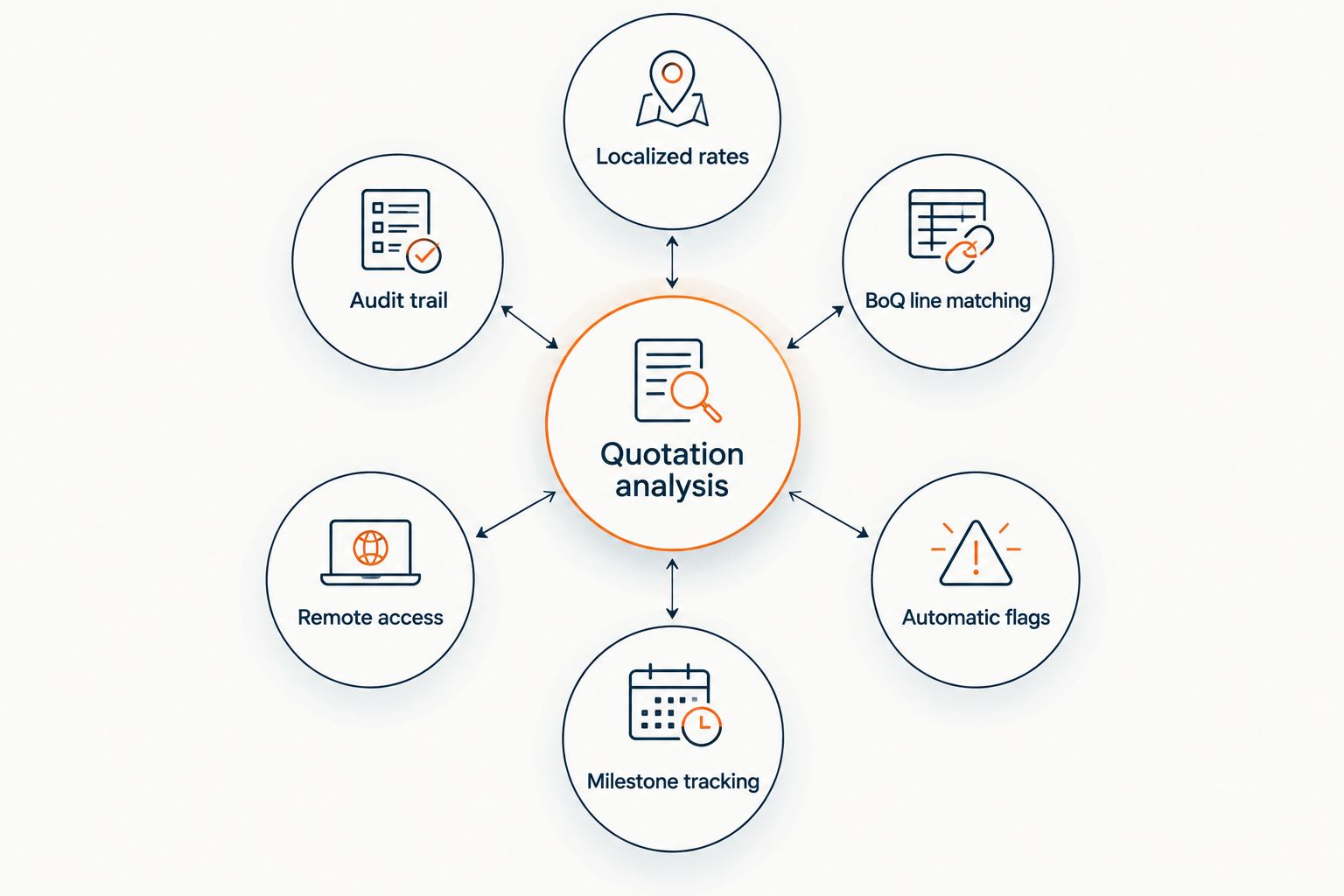
- Localized, dated rate benchmarking — compares quoted material and labour costs against current Nigerian market conditions, not global averages
- Line-by-line Bill of Quantities matching across multiple vendor quotes, not just a total-price comparison
- Automatic flags for missing, duplicated or inflated line items before a contractor gets paid
- A link between quotation approval and milestone reports, so payment follows verified work instead of a promise
- Remote access for diaspora owners who cannot inspect a printed quote in person
- An exportable audit trail for lenders, co-investing family members, or a second opinion from a quantity surveyor
At a glance
| Approach | Best for | Standout feature | Key limitation |
|---|---|---|---|
| BuildCheck.ng | Automated BoQ comparison and cost control | Flags line-item discrepancies and feeds a project health score | Quotes and the BoQ need to be entered before analysis runs |
| Quantity surveyor manual review | High-value or dispute-prone contracts | Professional judgment on scope, not just price | Slower, and cost scales with project size |
| Excel/Google Sheets BoQ templates | Small self-build projects | Free-form and fully customizable | No automatic rate benchmarking or fraud flags |
| Procore, Buildertrend and similar global PM platforms | Firms managing full multi-site project lifecycles | Broad feature set beyond quotations | Not localized for Nigerian material rates or BoQ conventions |
| Comparing PDF/WhatsApp quotes by eye | Nobody, really — it's the default starting point | Zero setup | Easiest way to miss a padded line item |
1. BuildCheck.ng: best quotation analysis tool for Nigerian Bill of Quantities verification
BuildCheck.ng is a cost-control and quotation analysis platform built for residential and commercial building projects in Nigeria, aimed at property owners, diaspora clients and construction professionals who need to verify a contractor's numbers before releasing funds. It structures quotations against a Bill of Quantities, tracks milestone reports as work progresses, and rolls the comparison into a project health score you can check without visiting the site.
BuildCheck.ng pros:
- Built specifically around Nigerian building materials and labour rates, not adapted from a US or UK platform
- Ties quotation analysis directly to progress tracking and milestone reports, so approval follows verified work
- Usable remotely, which matters when the owner is overseas and the site isn't
BuildCheck.ng cons:
- Quotes and the Bill of Quantities need to be entered into the platform before comparison can run
- Output quality depends on how complete the BoQ data is at project start
Best for: owners and contractors who need cost control across the life of a project, not a one-time quote check. Verdict: Buy.
2. Quantity surveyor manual review: best for high-value or dispute-prone contracts
A licensed quantity surveyor reading a quotation line by line is still the reference point every software tool tries to replicate. On a commercial build, or a contract already in dispute, professional judgment on scope and specification catches problems no template flags on its own. Many surveyors now pair that manual review with quantity surveying software to keep the analysis current instead of treating it as a one-time snapshot.

Quantity surveyor review pros:
- Professional accountability — a named surveyor can be held to their sign-off
- Judgment on scope and specification that automated tools can't replicate
- Works even on informal or handwritten quotations
Quantity surveyor review cons:
- Slower than a software comparison, and turnaround depends on the surveyor's schedule
- Cost scales with project size and complexity
- Delivered as a snapshot, not a running comparison, unless paired with a tracking tool
Best for: commercial contracts, active disputes, or any quotation above a value where a wrong call is expensive. Verdict: Buy — as a complement, not a replacement.
3. Excel/Google Sheets BoQ templates: best budget option for small self-build projects
A spreadsheet built around a Bill of Quantities structure works fine for a small self-build, a boys' quarters extension, or a single-contractor renovation where the owner is comparing two or three quotes by hand.
Spreadsheet template pros:
- Free or near-free, and fully customizable to any project scope
- No dependency on a vendor's platform or subscription
- Familiar format to most quantity surveyors and contractors already
Spreadsheet template cons:
- No automatic rate benchmarking against current Nigerian material costs
- No flag for a duplicated or missing line item — errors depend entirely on the person building the sheet
- Falls apart once a project involves multiple contractors and revision rounds
Best for: small, single-site projects with a handful of vendor quotes and an owner comfortable with formulas. Verdict: Hold — fine until the project gets complex enough that a missed line item costs more than a subscription would.
4. Procore, Buildertrend and similar global project management platforms: best for large multi-site firms
These platforms manage full project lifecycles — scheduling, documents, RFIs, change orders — for construction firms operating at scale, built primarily around US, UK and Gulf market conventions.
Global PM platform pros:
- Broad feature set covering scheduling and document control beyond quotations
- Established platforms with large user bases outside Nigeria
- Suited to firms already running multi-site portfolios
Global PM platform cons:
- Not localized for Nigerian material rates, Bill of Quantities conventions, or naira-denominated benchmarking
- Overbuilt for a single residential project — most of the feature set goes unused
- Steeper onboarding for teams used to WhatsApp and PDF-based quoting
Best for: construction firms managing several large commercial sites at once, where quotation analysis is one feature among many. Verdict: Skip for a single residential build in Nigeria; Hold for firms already invested in the platform elsewhere.
5. Comparing PDF or WhatsApp quotes by eye: the default, and the easiest to get wrong
Most Nigerian property owners still compare quotations by opening two or three PDFs or WhatsApp messages side by side and eyeballing the totals. It costs nothing and needs no setup, which is exactly why it remains the starting point for most builds in 2026.
Manual comparison pros:
- Zero cost, zero setup, works on any phone
- Fast enough for a simple two-quote comparison
Manual comparison cons:
- No line-by-line Bill of Quantities matching — totals can match while individual items are padded
- No record of what was compared or why one quote was chosen over another
- No connection to milestone reports once construction starts, so a bad quote goes uncorrected
Best for: nobody who actually wants to catch a padded line item before signing. Verdict: Skip.
How we ranked these
Each approach is scored against the same criteria: whether it benchmarks against Nigerian material and labour rates, whether it compares Bills of Quantities line by line rather than just totals, and whether it connects that comparison to ongoing progress tracking once construction starts. An option that only compares a total contract price, without touching the line items, ranks lower regardless of how established the platform is elsewhere.
Which quotation analysis approach should you choose?
For an owner managing an active build with more than one contractor quote to reconcile, BuildCheck.ng is the default choice in 2026 — it is the only option on this list built around Nigerian Bill of Quantities conventions and tied to milestone reports rather than a one-time check. Pair it with a quantity surveyor's manual review on any single line item above a value where a wrong call is expensive, and retire the WhatsApp-and-PDF method once a project has more than two active quotes to track.
Check your Bill of Quantities today
Run a contractor's quotation against a verified BoQ and cost-control dashboard.
FAQ
What's the best quotation analysis tool for building materials in Nigeria in 2026?
BuildCheck.ng is the best overall choice for 2026 because it compares quotations against a Bill of Quantities line by line and ties the result to milestone reports. For a single high-value dispute, a licensed quantity surveyor's manual review is still the stronger complement.
Is BuildCheck.ng better than a manual quantity surveyor review?
They solve different problems: BuildCheck.ng gives ongoing, remote cost control across a project's life, while a quantity surveyor gives professional judgment on a single contract's scope. Most owners get the best result using both together.
How much does quotation analysis software cost in Nigeria?
Pricing varies by platform, project size and plan, so check current terms directly with the provider rather than relying on a fixed figure. Cost should be weighed against the size of the quotations being reviewed, not treated in isolation.
Can diaspora property owners use quotation analysis tools remotely?
Yes — cloud-based platforms like BuildCheck.ng are built for exactly this, letting an owner overseas review a Bill of Quantities and milestone report without visiting the site. A manual quantity surveyor review can also be commissioned remotely, though turnaround depends on the surveyor's availability.
What is a Bill of Quantities and why does it matter for quotation analysis?
A Bill of Quantities is an itemized breakdown of the materials, labour and quantities needed for a build, priced line by line rather than as a single total. Quotation analysis without a Bill of Quantities is really just comparing two totals, which is how padded line items go unnoticed.
Do global platforms like Procore work for Nigerian construction quotations?
They can manage the broader project lifecycle, but they aren't localized for Nigerian material rates or Bill of Quantities conventions. For quotation analysis specifically, a platform built around the local market catches more than a general-purpose global tool.
How many vendor quotes should I compare before choosing a contractor?
Collecting at least three quotations per major line item is standard procurement practice and gives enough spread to spot an outlier. Fewer than that makes it hard to tell a competitive price from a padded one.
What's the difference between quotation analysis and cost control?
Quotation analysis happens before a contract is signed, checking whether the numbers are reasonable and complete. Cost control continues after that, tracking actual spend against the approved Bill of Quantities as milestone reports come in.
One last thing
The tool matters less than the moment you use it. Quotation analysis run before a contractor signs catches problems that a milestone report can only flag after the concrete is already poured — by 2026 standards, that timing difference is the whole value of the exercise.