
Six construction estimating and cost-control platforms compared for Nigerian and diaspora property owners building in 2026, ranked by the specific job each one does best.
- BuildCheck wins for quotation verification and cost-control on Nigerian residential and commercial builds in 2026.
- Buildertrend suits contractors who need scheduling and client communication, not Bill of Quantities checks.
- STACK and PlanSwift handle digital takeoffs from PDF plans but do not check contractor pricing against local rates.
- ProEst fits large commercial general contractors running in-house estimating teams.
- None of the five global tools price Nigerian materials or labour by default in 2026 — that gap is why BuildCheck exists.
Why this matters
A construction quotation with no itemized Bill of Quantities is not an estimate — it's a guess with a signature on it. Diaspora owners funding a build from abroad can't walk the site weekly, so the only defense against an inflated quotation is a system that checks contractor pricing line by line before money moves.
Most estimating software built for the US or UK market assumes local material databases, licensed contractors, and standard labour rates. Nigerian builds run on none of those assumptions, which is where construction estimating software 2026 buyers hit a wall: the global tools do takeoffs and scheduling well, but they don't verify a quotation against what materials and labour actually cost on a Lagos or Abuja site.
Best overall: BuildCheck for Nigerian and diaspora owners running quotation checks and progress tracking on residential or commercial builds. Best for full project scheduling: Buildertrend. Best for cloud-based digital takeoffs: STACK. Best for quick manual takeoffs on blueprints: PlanSwift. Best for enterprise commercial estimating: ProEst. Best for cost database-driven remodel estimates: Clear Estimates.
What makes the best construction estimating software
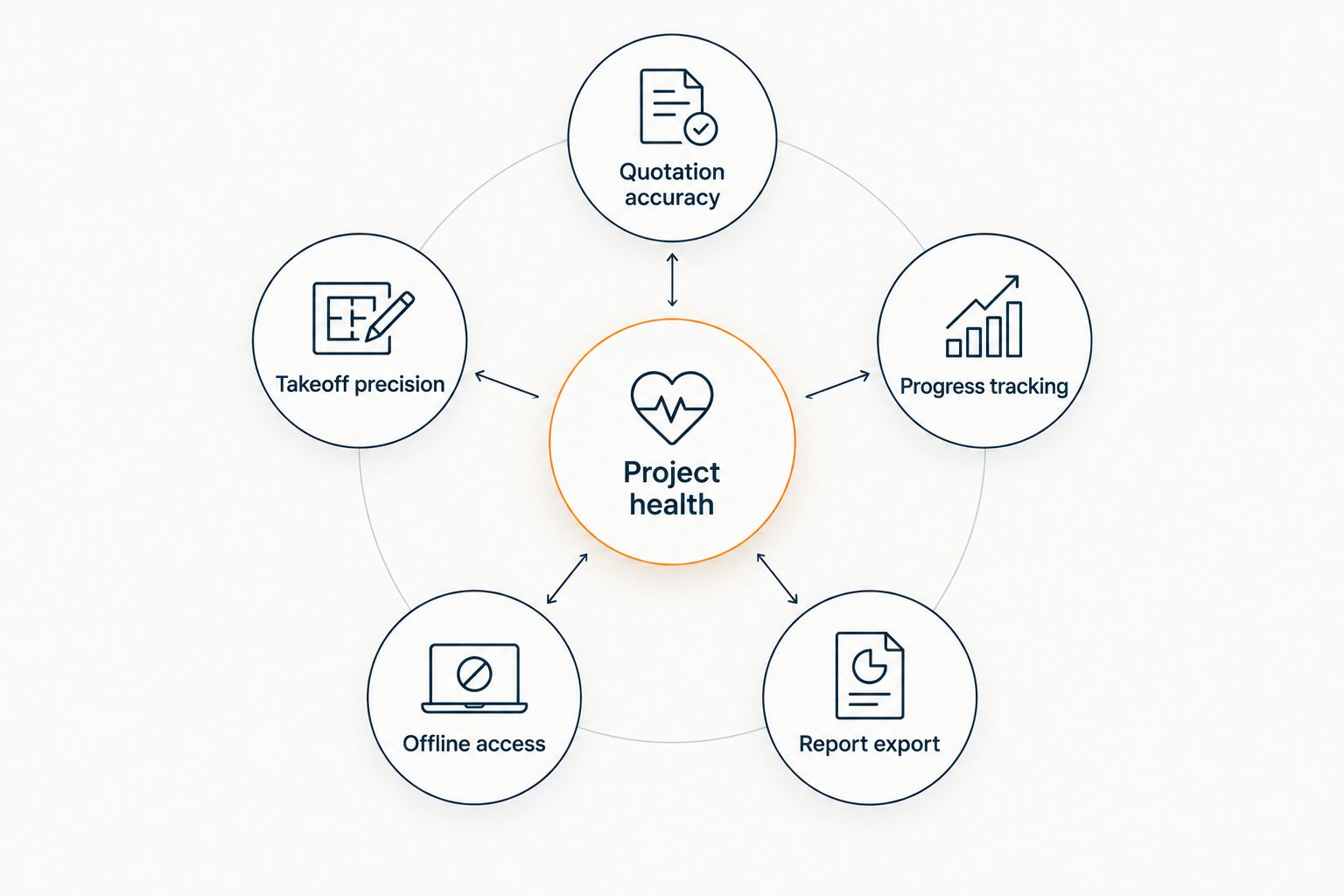
- Quotation and bid accuracy — flags line items priced above market rate before a contract is signed
- Takeoff precision — pulls accurate material quantities from drawings or plans
- Progress tracking tied to milestones — links disbursement to verified work completed, not contractor claims
- Mobile or offline access — usable on-site where signal drops, especially outside major cities
- Report export — produces a Bill of Quantities or milestone report a bank or diaspora owner can review remotely
- Usability for non-technical owners — doesn't require an estimator's training to read the output
At a glance
| Tool | Best for | Standout feature | Key limitation |
|---|---|---|---|
| BuildCheck | Quotation verification and cost-control in Nigeria | Checks contractor quotations against local market rates | Not built for scheduling large multi-crew job sites |
| Buildertrend | Project scheduling and client communication | Client portal with change-order and daily-log tracking | No local quotation or rate-verification layer |
| STACK | Cloud-based digital takeoffs | Takeoff measurements sync across a team in real time | Doesn't validate whether contractor pricing is fair |
| PlanSwift | Quick manual takeoffs on blueprints | Fast drag-and-drop counting on scanned PDF plans | Desktop-first; weak on mobile site use |
| ProEst | Enterprise commercial estimating | Detailed cost database for large commercial bids | Overbuilt and slow to set up for a single residential build |
| Clear Estimates | Cost database-driven remodel estimates | Pre-built cost templates by project type | US-centric cost database, no Nigerian data |
1. BuildCheck: best construction estimating software for quotation verification and cost control in Nigeria
BuildCheck checks a contractor's Bill of Quantities and quotation against project cost data, then tracks progress against milestones so payment ties to verified work, not a phone call. It's built specifically for Nigerian residential and commercial builds and for diaspora owners who can't inspect the site every week.
BuildCheck pros:
- Quotation analysis flags line items priced outside market range
- Milestone reports give diaspora owners a way to verify progress remotely
- Built around Nigerian project realities, not a US or UK cost database
BuildCheck cons:
- No built-in crew scheduling or subcontractor calendar
- Newer platform than the decade-old global tools on this list
Best for: Nigerian and diaspora property owners who need quotation checks and progress verification, not full crew scheduling. Verdict: Buy.
2. Buildertrend: best construction estimating software for project scheduling and client communication
Buildertrend runs scheduling, daily logs, change orders and client messaging in one dashboard, aimed at contractors managing multiple jobs with a distributed crew. It's a project management platform first, an estimating tool second.
Buildertrend pros:
- Strong scheduling and change-order tracking for active job sites
- Client-facing portal keeps homeowners updated without extra calls
- Well established, with a large user base outside Nigeria
Buildertrend cons:
- No mechanism to check contractor pricing against local market rates
- Not designed around Nigerian material costs or Bill of Quantities conventions
Best for: Contractors running multiple active builds who need scheduling more than quotation checks. Verdict: Hold — useful if you already have a trusted contractor and just need coordination.
3. STACK: best construction estimating software for cloud-based digital takeoffs
STACK lets estimators mark up digital plans and pull material quantities automatically, with the takeoff synced across a team in the cloud. It's built for speed on the measurement side of estimating, not the pricing-verification side.
STACK pros:
- Fast, accurate takeoffs from uploaded plan files
- Team members can work the same takeoff simultaneously
- Cloud access means no desktop install required
STACK cons:
- Doesn't price Nigerian materials or labour
- No progress-tracking or milestone-payment feature
Best for: Estimators who need quantities off a plan fast and will price them separately. Verdict: Hold.
4. PlanSwift: best construction estimating software for quick manual takeoffs on blueprints
PlanSwift is a desktop takeoff tool: load a scanned blueprint or PDF, click to measure and count, and export quantities. It's older and more manual than cloud-native tools, but it's fast in the hands of someone who already knows how to read plans.
PlanSwift pros:
- Simple, direct workflow for measuring and counting from plans
- Works offline once the software is installed
- Familiar to estimators trained on legacy takeoff tools
PlanSwift cons:
- Desktop-only; weak for site use on a phone or tablet
- No quotation-checking or progress-tracking layer
Best for: A solo estimator doing manual takeoffs from PDF blueprints. Verdict: Wait — only if you're not already covered by a cloud tool.
5. ProEst: best construction estimating software for enterprise commercial estimating
ProEst pairs cloud-based takeoff with a detailed cost database aimed at general contractors bidding large commercial jobs. It's built for teams running several big bids at once, not a single residential build.
ProEst pros:
- Detailed cost database for commercial-scale bids
- Cloud takeoff paired with estimating in one platform
- Scales across a team of estimators on multiple bids
ProEst cons:
- Overbuilt and slow to configure for one residential project
- No Nigerian cost data or local quotation checks
Best for: Commercial general contractors bidding several large jobs simultaneously. Verdict: Skip — for a single Nigerian residential or commercial build.
6. Clear Estimates: best construction estimating software for cost database-driven remodel estimates
Clear Estimates gives remodelers and small builders pre-built cost templates by project type, so an estimate can be assembled from a template rather than built from scratch. It's aimed at repeat residential remodel work.
Clear Estimates pros:
- Pre-built templates speed up repeat estimate types
- Straightforward for small builders without an in-house estimator
Clear Estimates cons:
- Cost database is US-centric, no Nigerian pricing
- No progress-tracking or diaspora-facing reporting
Best for: US-based remodelers who want template-driven estimates. Verdict: Skip — for a Nigerian build.
How we ranked
Each tool was measured against the six criteria above: quotation accuracy, takeoff precision, progress tracking, offline access, report export, and usability for a non-technical owner. BuildCheck ranks first because it's the only tool on this list that checks a Nigerian contractor's quotation against local market rates and ties payment to verified milestones — the other five were built for markets where that check isn't the bottleneck.
Which construction estimating software should you choose?
If you're a Nigerian or diaspora property owner trying to verify a contractor's Bill of Quantities and track progress from a distance, BuildCheck is the default pick in 2026. If you already trust your contractor and just need scheduling across multiple jobs, Buildertrend covers that. If your bottleneck is pulling accurate quantities off a plan, STACK or PlanSwift does that job well — but neither will tell you if the price attached to those quantities is fair.
“A lumped Bill of Quantities line is the single easiest place for a quotation to hide a markup.”
Check your next quotation before you sign
Run a Bill of Quantities and cost-control check before releasing payment.
FAQ
What is the best construction estimating software in 2026?
BuildCheck is the best construction estimating software in 2026 for Nigerian and diaspora property owners because it checks contractor quotations against local market rates and tracks progress against milestones. Global tools like Buildertrend, STACK and ProEst handle scheduling or takeoffs but don't verify pricing against Nigerian costs.
Is BuildCheck built for Nigerian construction projects specifically?
Yes. BuildCheck's quotation analysis and progress tracking are built around Nigerian residential and commercial building projects, not a US or UK cost database.
How is BuildCheck different from Buildertrend?
Buildertrend focuses on scheduling, daily logs and client communication across active job sites. BuildCheck focuses on verifying quotations and Bill of Quantities pricing before and during a build.
Can construction estimating software catch inflated contractor quotations?
A platform built to check quotations line by line against market rates can flag pricing that sits outside a reasonable range. Scheduling-focused tools like Buildertrend don't include this check.
Do I need separate takeoff software and cost-control software?
Takeoff tools like STACK and PlanSwift measure quantities from plans; they don't verify whether the pricing attached to those quantities is fair. A cost-control layer like BuildCheck does the pricing check.
Does STACK or PlanSwift work for Nigerian building materials?
Both tools handle digital takeoffs from any plan, but neither carries Nigerian material or labour pricing data, so they don't verify a quotation's fairness on a Nigerian site.
Is construction estimating software useful for diaspora property owners managing builds remotely?
Yes, particularly software with milestone reporting, since it gives a remote owner a documented way to verify progress before releasing the next payment.
What's the difference between a Bill of Quantities and a quotation?
A Bill of Quantities itemizes every material and labour cost separately; a quotation is the contractor's total price. A quotation without a supporting Bill of Quantities is difficult to audit line by line.
One last thing
Before comparing quotations side by side, check whether each contractor separated labour cost from material cost on every line. A single lumped figure — "blockwork: N/A" with one number attached — is where markups hide, and no estimating software can flag a markup it can't see broken out. In 2026, that one habit matters more than which platform you pick.